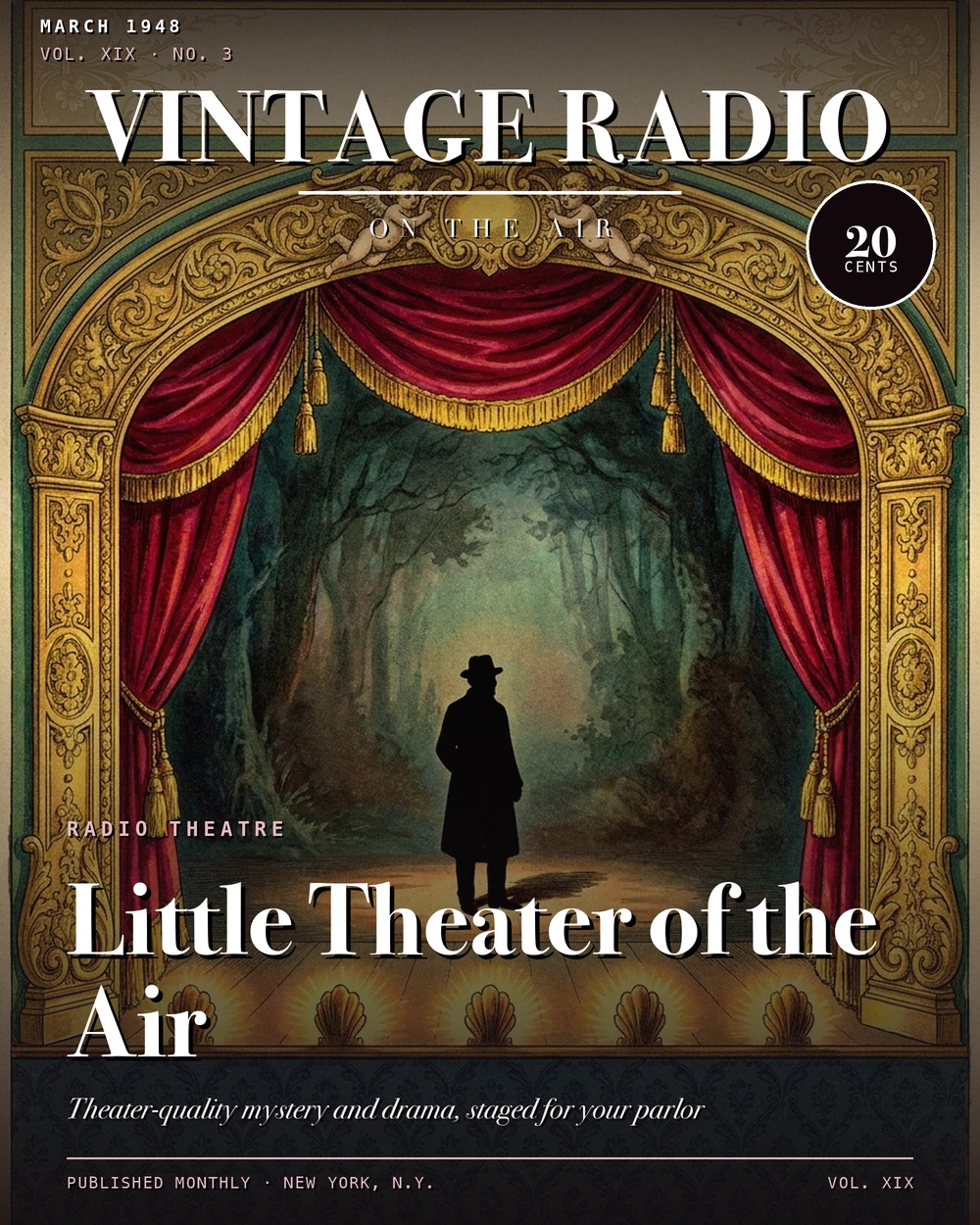
Little Theater of the Air
What the Show Was
Little Theater of the Air was a mystery and drama anthology program that ran during the 1940s, presenting what its producers clearly intended as a domestic substitute for the stage: original plays and adaptations of classical works, performed with the kind of care you'd expect from a live theatrical production rather than a quick radio filler. The title itself announced the ambition — a little theater, right in your living room.
The format was the anthology, which gave the show room to roam across different kinds of stories rather than locking into a single recurring character or situation. Mystery anchored much of the output, but the program drew from a wider range of dramatic material, episode to episode. What held it together was the consistency of execution — high-quality production values, a talented cast of voice actors, and a purposeful approach to sound design that made the most of what radio could do that the stage couldn't.
How It Sounded
Sound effects on Little Theater of the Air were not mere decoration. Anthology drama on radio lives or dies by its ability to build a world quickly — you have no sets, no costumes, no lighting — and the production's approach to sound was a direct response to that problem. The innovations associated with the show's runtime helped place the listener inside each story rather than just alongside it.
The cast of voice actors working on the program gave the material the range an anthology format demands. Episode to episode, the stories called for different tones, different paces, different emotional registers, and the performances apparently delivered. A show that asked its actors to carry "The Nameless Day" one week and "Castle By The Sea" the next needed flexibility from its ensemble, and the production seems to have found it. Titles like "Hansen's Ghost," "Dark House," and "Crimson Hand" suggest the range of atmospheric territory the writers were staking out.
The episode titles that survive in the broadcast catalog give a reasonable picture of the show's texture. "Lost Black Crow Mine," "Man With White Hair," "Mr. Randall's Discovery," "Author of Murder," "Fever," "The Professors Elixir," "House with a Past" — these are stories built around secrets, wrongdoing, and unsettling discoveries. The mystery frame is consistent, but the individual settings and premises vary enough that the anthology structure genuinely served the material.
What Survives
Thirty-one episodes of Little Theater of the Air are preserved in the broadcast catalog. That's a partial run — the show aired across most of the 1940s, and a complete record of every episode produced has not come down to us. This is consistent with how 1940s radio generally fared: recordings were often made onto transcription discs for distribution or rebroadcast, not for preservation, and a significant portion of the decade's output was simply lost.
What the 31 preserved episodes represent is a working sample of the show's range and approach. Titles like "The Nameless Day," "Fever," and "House with a Past" sit alongside more overtly atmospheric entries like "Dark House" and "Castle By The Sea." Across this surviving run, the show's character comes through: a commitment to drama that took itself seriously, stories built around tension and unease, and a production style aimed at quality rather than quick turnover.
The show is not among the most documented programs of its era. No exhaustive production record, no major critical retrospective, and no detailed cast directory have surfaced. What's known comes largely from the episodes themselves and from the broader context of 1940s anthology radio. That limited documentation is itself part of the historical picture — Little Theater of the Air was one of many programs competing for audience attention in a crowded field, and not every show from that era left a paper trail to match what it achieved on air.
Why It Mattered
The mystery and drama anthology was a well-established format in 1940s radio, and Little Theater of the Air operated within a competitive landscape where audience attention was hard to hold and easy to lose. The show's reputation as a forerunner in radio drama — and its credited influence on future mystery radio programs — suggests it was doing something with the format that registered with listeners and with the people making radio at the time.
The ambition to deliver theater-quality experience through a domestic speaker was not unique to this program, but the consistent emphasis on production values, sound craft, and strong voice performance gave it a particular identity within the anthology field. Mystery as a genre suited radio unusually well: the medium's reliance on imagination rather than spectacle made it natural territory for stories built around what you couldn't quite see, what you couldn't quite explain. Little Theater of the Air understood that fit and worked it deliberately.
The Golden Age of radio, roughly 1930 through the end of the 1940s, was the period when commercial broadcasting grew into the fabric of daily American life. Shows like this one were part of how that happened — programs that treated the form as worth taking seriously, that aimed at something more than ninety seconds of laughs or a quick procedural beat. For listeners who came to it in the 1940s, Little Theater of the Air offered what the theater offered — a complete imaginative experience — without requiring anything beyond a radio set and a willing ear. That was the original proposition of the little-theater idea, and by the evidence of what survives, the program made a genuine effort to deliver on it.